Stewart, Clare, Michael and Tom and their team are farmers near Doncaster, farming around 800 hectares of mixed arable, grass and sheep. They participated in LENs in 2024 and have benefitted from two years of multiple measures.
“We did a few regenerative things on the farm before we joined LENs,” says Michael. “But being part of the programme has focused our minds and we’re really beginning to see the benefits. For example, direct drilling a field next to one that wasn’t and the difference is very noticeable. The soil structure after direct drilling is far superior – you don’t get mud on your boots from it on a wet day like you do from the one next to it. We see many more birds foraging on the direct drilled area, which shows that there must be more invertebrates for them to feed off.”
He cites snipes, woodcock, lapwing over winter and they are returning in numbers to the farm, which he hadn’t seen for years. The Game and Wildlife Conservation Trust measures the increase in birdlife on the farm.
The wildflower strips that were funded through LENs and planted in 2024 are now doing really well. And he was able to invest significantly into improving hedgerows and laying new ones.
In 2025, he bid for and was able to implement four different measures on his farm: managing hedgerows to benefit wildlife, planting new cross-slope hedges, subsoiling and the farmer cluster support package, which supports members of the Limestone Ridge Nature Recovery Group to restore nature on a landscape scale across their farms South Yorkshire.
“It’s the flexibility that I appreciate most,” he said in a recent interview. “You can pick and choose what’s right for your farm, which isn’t always the case with funding schemes. And LENs goes much further than other schemes.”
He’s hoping to secure further funding in the 2026 trade, including resilience payments now that he is further along the regen pathway.
Michael’s main message for anyone thinking about thinking of LENs funding is to go ahead and apply. “There’s a real mix of measures to consider and I think that having funding available for innovations that farmers want to try out is one of the best things.”
Michael values that LENs brings farmers and funders together, saying: “It’s good that food producers are investing in nature and regeneration. The country’s food supply chain depends on building more resilience and farmers can’t do this alone. We need financial support to make sure our farms are healthy and contribute to protecting and encouraging nature.”
Profile
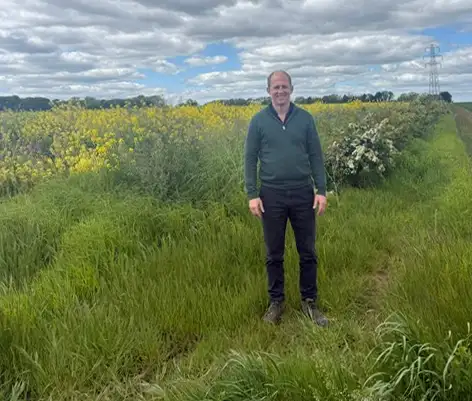
Michael Woolhouse
From right to left the photograph shows multiple measures: winter wheat; three-metre flower margin; four year old new hedge and tussocky grass margin; a three-metre beetle bank; a three-metre advanced Wild Bird mix (Wild bird seed and flowers) and an OSR crop. Until the hedge was planted, the two neighbouring crops adjoined with no habitat.