News
Claire Donkin becomes LENs farmer of the year 2026
14 July 2026
Claire Donkin of Donkin Farms has been awarded the title of LENs farmer of the year 2026.
In an outstanding application, Claire demonstrated the impact that support from LENs has already made to her farm, which she took over from her father in 2024.
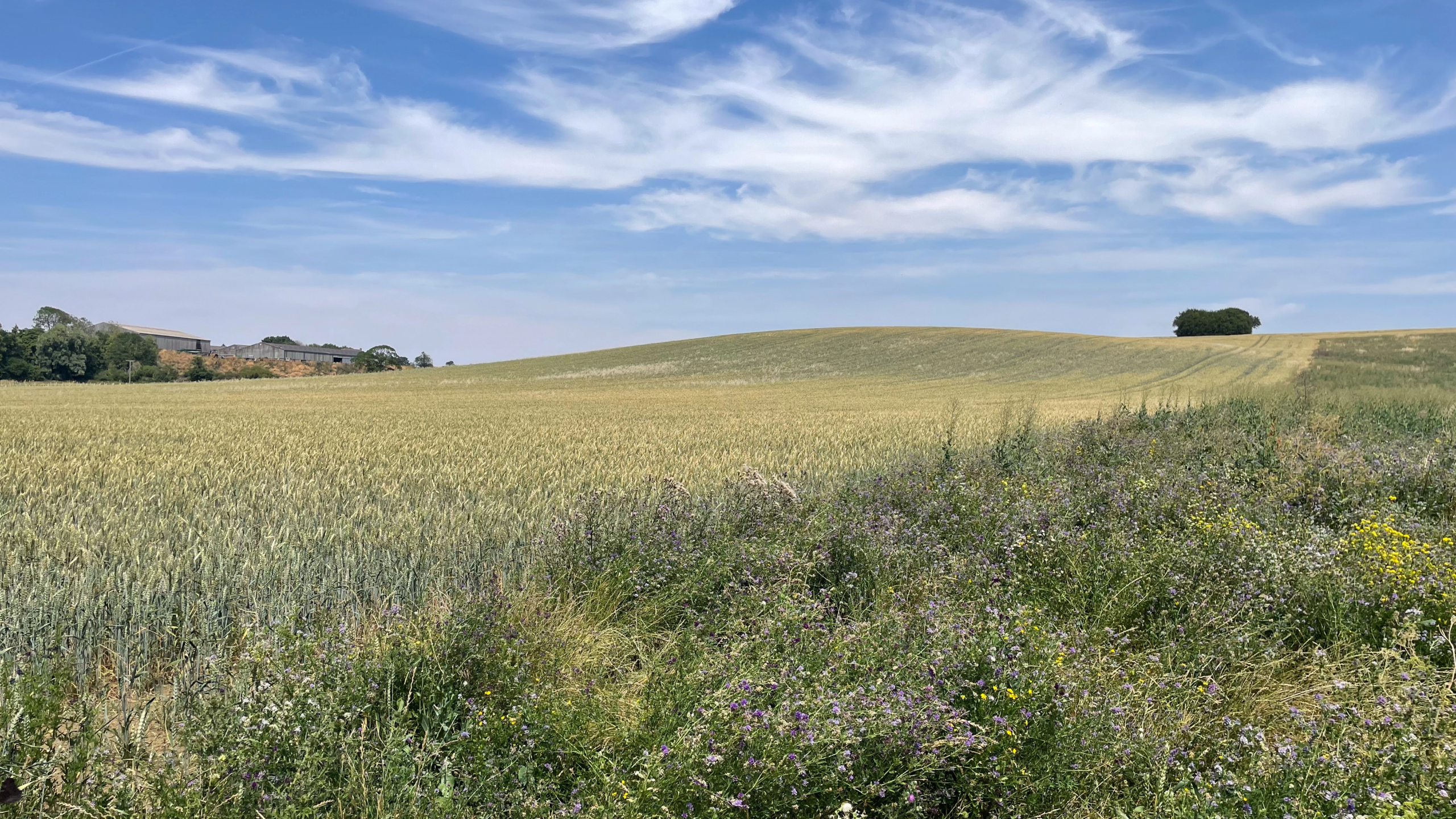
Donkin Farms covers 78 hectares of arable, mainly wheat and Claire’s father had worked the land for many decades until he was 92. He had used long-established farming methods and Claire saw that something had to change if the land was to remain productive now and in the future. In her application, she explained: “Years of financial pressure, declining soil function, drainage problems, and increasing weed burden, particularly blackgrass, had left us in a cycle of real vulnerability. Our challenge wasn’t simply to improve yields, we’ve made that mistake before. We needed to rebuild resilience, both environmental and financial, and create a system capable of supporting the next generation.”
Before she heard of LENs, Claire had already introduced regenerative measures through the Government’s Sustainable Farming Incentive. She turned to LENs for support to try new things to further boost resilience.
LENs first supported Claire in the 2025 trade cycle, funding pesticide (herbicide, insecticide, fungicide) reduction approaches, which involved companion crops to aid soil structure and nutrient use efficiency; and integrating fertiliser and manure nutrient supply.
Claire’s focus is on addressing the causes of vulnerability rather than simply reacting to the symptoms, so that weather extremes “no longer feel as threatening.” In her application, she explained that: “Historically, areas of the farm were trapped in a cycle of poor drainage, declining structure, weed pressure and erosion. Small problems often became larger ones because the underlying soil function was compromised.”
Following drainage improvements, legume leys and with a greater focus on biological processes, Claire is beginning to see soils recover their ability to function, saying that “Water moves more effectively through the profile, and crop establishment this spring was remarkably consistent. Previously challenging areas are starting to recover.”
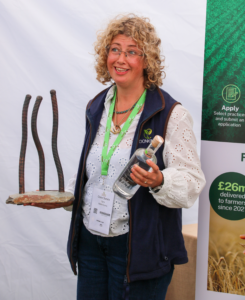
Claire accepting her award at Groundswell. The prize is a trophy designed by Eryka Isaak and an engraved bottle of Arbiki Nadar gin.
What impressed us most was how much impact Claire has achieved on her farm in such a short space of time. She embraces a mindset that is all about building long-term resilience and she was clear how LENs had allowed her to make those changes, by giving support for methods and measures that had been untried on that land before she took over.
Chantal Brown, LENs Regenerative Farming Advisor on Claire’s approach to soil health.
Accepting the award, Claire said:
I became aware of LENs at an opportune, pivot moment. We’re a small farm in the grand scheme of arable. To create impactful change was a huge risk to our limited capital resource. LENs offered us a way to de-risk the changes we wanted to make. And I feel it’s been a huge success. I never thought when we took the farm on that we’d be in such a positive place in such a short time and that we would have done so much.
She paid tribute to her agronomist, Alice Bourne, who, Claire said “has driven so much of the work and has made my ideas happen.”
What I am most proud of is that we chose to be brave. Rather than chasing short-term gains, we’ve invested in changes where the benefits aren’t always immediate but where we believe the long-term rewards for the farm, the environment and our community will be significant.
On a farm this size, every hectare has to deliver. We want to produce food, that’s what we’re here to do. But we also want biodiversity, carbon storage, healthier soils, and a stronger future for the land that we care for.