Doug and Pam Dear have a 1600-acre farm near Selby in North Yorkshire, England. Doug’s family has been on the farm for over 100 years and these days, the primary business is cattle finishing, with a mix of crops, including wheat, forage maize, fodder beet, winter barley and rapeseed oil.
Doug and Pam were among the first farmers to get involved in LENs Yorkshire and we recently interviewed Doug to find out how the experience has been so far.
When did you first start introducing regenerative agriculture practices to your farm?
I would argue that we’ve always been regenerative because we have a wide rotation of crops, have grasses in the rotation and have livestock on the farm. But we’ve certainly focused our minds since we’ve been part of LENs. Me and Philip Raley were the two pilot farmers at the start in Yorkshire. So, this is our third year.
We don’t do a lot of cover cropping because the combine comes out of the field in the middle of August and four weeks later, we’re back into winter crops. We hardly grow any spring crops. Instead, we put livestock back into the arable rotation and put stubble turnips in, which is either a cover crop or a cash crop.
So, wherever is going to be maize, potatoes, sugar beet or fodder beet the following year, gets stubble turnips put on it. And the sheep are grazing from January through to early April.
We’ve teamed up with another chap and he puts a couple of thousand store lambs on it, so it’s working on every level.
Collaboration seems to be an important part of the LENs experience for you.
We have a group of nine or ten of us and the group is collaborative. We go around each other’s farms and offer constructive criticism, look at what we’re each doing and take ideas away. It’s quite nice to get off the farm and meet with like-minded people. We’re all very ‘open book’ about sharing.
What are the key changes that you’ve made since you joined LENs?
I would say that before LENs, we were 80% of the way there. Reduced cultivation is something we’ve taken on board. We hardly plough anything now. That’s a progression and helped by funding from LENs.
We scaled up the introduction of livestock into the arable rotation in a massive way and the funding helped us move that forward.
We have some land that two generations ago would have been grass, with beef or dairy cows. It had become poor cereal land and we’ve taken that out of production and put grass in with legumes instead. We’ve expanded that from a one-year rotation to three. It works well for us because we can plant that grass and feed it to the cattle. So instead of pushing cereals that don’t do very well and applying chemicals that were becoming inactive against black grass and rye grass, we’ve just given the land a rest with the grass. That would have never got to the scale it was without LENs pushing and funding it.
Can you tell me about the demo farm trial you were part of?
We had Nestlé, the other funders and all the farmers here and at a couple of other farms. And we demonstrated some of the things that we’d done. It was a good learning curve for both the farmers and Nestlé. It’s always better when you get people on farm because they understand the concepts of what we’re trying to achieve. Farming is so regional, so it’s good for them to see that one size doesn’t fit all. We demonstrated grasses with legumes in and how we put MZ28 on the wheat as a liquid nitrogen source. And then we went to Phillip Raley’s farm to see how he’d grown wheat without any inputs whatsoever.
This year, we’ll have another demonstration day and we’ll meet somewhere else within the group and have a look at what they’ve done and learn from it. It’s good having the big companies on farm to see the reality of what their supply chain looks like. I know nothing about making dog food and they know nothing about farming, so we all learn from each other. It’s good for them to see the realities of farming. You can do the absolute best you can and then the weather comes along and just completely spoils it and that’s completely out of your control.
What would you recommend to farmers who aren’t already in LENs, who are thinking of joining?
What have you got to lose? There’s good funding for things that you may want to do. And you get to share ideas with the rest of us and learn from each other. It takes some of the financial risk
out of trying something new.
We would never have tried the foliar-applied fertiliser without some of the risk being removed. And we probably would never have put down the amount of grass that we have without LENs. If you have an idea, or you’re doing something on a very small scale, it will give you the opportunity to run with it and scale it up if it works.
Profile
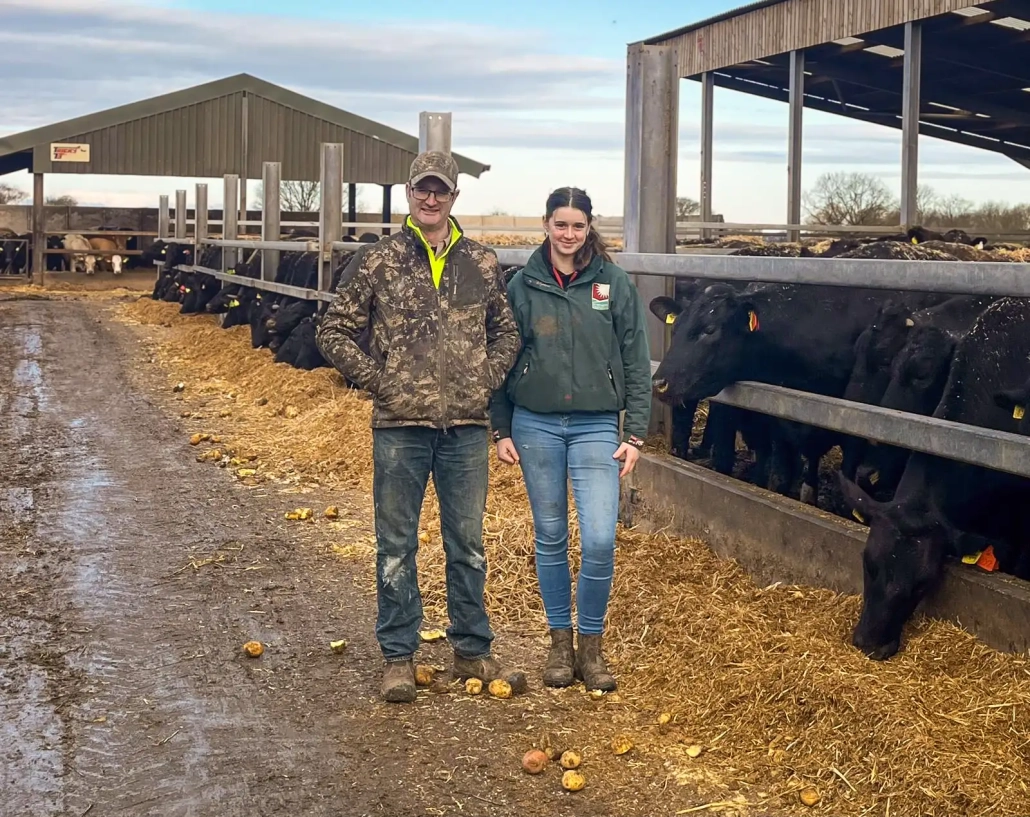
Doug and Charley Dear