Measure spotlight: innovative monitoring
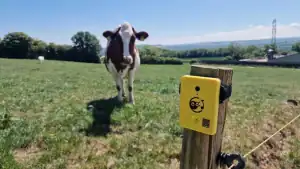
A new measure for 2026 is ‘Innovative monitoring’, a broad measure, which allows you to apply for funding for a tool or app that you would find useful for monitoring soil health, plant health or biodiversity on your farm. Here are my top 3 picks for more hands-on monitoring:
1. The sound of a healthy farm: monitoring biodiversity with Chirrup AI
There is an intrinsic link between a productive farm and the birds that call it home. Of all the wildlife on the land, birds often hold a special place in a farmer’s heart, whether it’s the resident owls in the barn, or the simple joy of hearing the first skylark in spring. Beyond the sentiment, birds are vital indicators of ecosystem health. They provide us with real-time signs of landscape resilience and the success of our environmental stewardship.
Supporting our farmland birds
Across many of our LENs regions, we provide funding for habitat creation that directly benefits these species, from restoring hedgerows to planting wild bird seed mixes to see them through the “hungry gap” in winter. Because birds respond so rapidly to both positive and negative changes, they are the perfect metric for measuring the impact of your hard work.
Introducing Chirrup AI
To help you (and us) better understand the birdlife on your land, we are using Chirrup AI. This tool allows us to monitor bird species diversity and recognize which species are thriving due to positive management actions on your farm.
How it works:
- Simple setup: acoustic monitors are positioned around your farm for 21 consecutive days between March and August.
- Advanced analysis: the audio is analysed by proprietary AI trained on thousands of hours of data and validated by experts.
- Long-term tracking: following an initial baseline in Spring 2027, we plan to return for follow-up monitoring 3–5 years later to track your progress.
Chirrup AI is already proven across the UK, Ireland and Western Europe, and we want to bring its insights to our LENs regions.
If you are interested in seeing and hearing how your conservation efforts are paying off, we would love to hear from you – please email Chantal to register your interest.
2. Beyond the surface: tracking soil health with Soilmentor
While birds reflect the health of the landscape above, the real engine of your farm is beneath your feet. Most of you are already in a rhythm of monitoring your soil through chemical analysis, but for those looking to get more “hands-on” with the physical and biological properties from season to season, we highly recommend the Soilmentor app.
Through a new collaboration with renowned soil guru Nicole Masters, the platform has launched the Soilmentor Regen Platform. This tool allows you to track your regenerative journey using bespoke benchmarking tailored to your specific soil texture, rainfall, and biome.
The 10 regen indicators
The platform focuses on 10 key metrics designed to give you a holistic view of your soil’s performance alongside the lab tests, and any sap, tissue and grain tests you are carrying out. Most of these can be completed with nothing more than a spade and the easy-to-follow video guides:
- Biological activity: earthworm counts and soil insect scores.
- Root & plant health: rooting depth, rhizosheaths, and legume nodulation.
- Soil structure: slake tests and water infiltration rates.
- Composition: % bare earth, brix barometer (plant sugars), and carbon stocks (top 30cm).
If a specific indicator (like infiltration) is lagging, the platform provides “Regen Pointers” from Nicole Masters, customized to your soil type, to help you improve.
Note: This tool is offered as a resource for your own management and is in addition to any standard LENs MRV (Monitoring, Reporting, and Verification) requirements.
3. Sap testing: letting the plant talk
If you want to know how your crop is truly performing, test the sap.
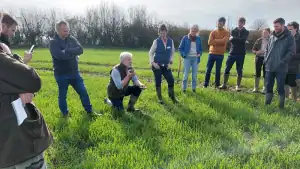
This month, I joined Tom Tolputt (TerraFarmer) and AHDB at Jeremy Padfield’s Stratton Farms in Wiltshire, where we recorded one the highest brix readings we have ever seen in a UK cereal crop. See the photo below for the proud moment of revelation:
The recipe for success
What made this specific field so special on 5 March? It wasn’t down to luck; it was a result of a carefully managed regenerative system:
- Stratton Farms have been using minimum till for 23 years, moving 2-3cm of soil.
- The previous crop was a two-year legume fallow, funded by the SFI, topped, then terminated with glyphosate and terradisced.
- Beowulf wheat was drilled on 13 October (drilling late is part of the black grass management) with a kickoff seed treatment, a biostimulant that claims to provide better germination and rooting and optimum plant health.
- The crop looks great as you can see from the photo and had not received any bagged Nitrogen at establishment or so far this spring. Applications will be using foliar Nitrogen that can be applied alongside humates. Through trials they have found when humates are applied, they can reduce their Nitrogen down to 100kg/N/ha and will expect to achieve at least 10tons/ha on this and most fields of wheat.
- When the farm needs to apply glyphosate, they use reduced rates of between 0.6 and 1.2litres/ha when mixed with humates which looks after the fungi and bacteria in the soil.
- Biochar is being trialled over the last two years with application at crop establishment.
Why brix matters
A refractometer (or “brixometer”) measures the sugar and mineral content in the plant’s sap and are a sign of a plant with a robust immune system and therefore better pest resistance, and superior nutrient density.
You don’t need a laboratory to get started. A simple refractometer, a sturdy garlic press (to squeeze the sap), and a few minutes in the field are all it takes to let your crops tell you exactly what they need. At LENs we are really interested in your brix readings, how they compare to field under different management and how readings increase as soil health increases over the years.
Pioneering the future
We are seeing an increasing focus on nutrient density from both supermarkets and consumers. By monitoring your Brix levels now, you are getting useful insights to the health of your plants and becoming an early pioneer, collating data, to evidence the impact of your regenerative management and the health of the food being being grown on the farm.