Lessons from the field: cutting inputs through livestock and foliar nutrition
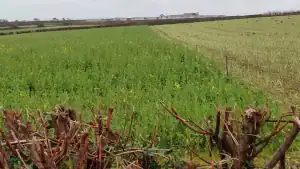
In March, Chantal was out with AHDB at a ‘resilient rotations’ event with Homer Farming Partnership and Monnow Agronomy. We looked at long term no till, use of biologicals and reducing synthetic chemical use. Geoff and the team manage three farms over 1100 tenanted hectares with 875 grazing dairy cows. The crop rotation is grass, maize, wheat, rye, spring barley, peas, OSR and cover and catch crops wherever possible.
As we look for ways to buffer our farming businesses against volatile input markets, I’ve focused on two strategies, which are proving their worth on the ground for the Homer Farming partnership.
1. Livestock integration: more than “just mowing”
Integrating sheep into cropping systems isn’t just about feeding livestock; it’s a sophisticated tool for crop health. By grazing crops in January and February, we’ve seen a “reset” effect that offers several biological wins:
- Disease Suppression: recent analysis of sheep-grazed Crusoe wheat showed a massive reduction in septoria, dropping from 62.2 DNA/mg to just 18.7 DNA/mg after only two weeks of grazing.
- Growth regulation & rooting: grazing stimulates deeper rooting and manages the canopy naturally.
- Nutrient Cycling: livestock provide an immediate “soil biology boost,” cycling nutrients and stimulating weed seeds for better control.
The farm has successfully reduced fungicide use to a maximum of just one application per year.
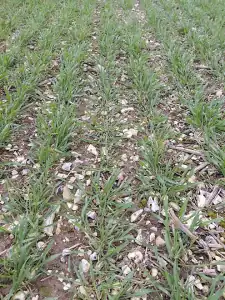 Wheat in early March following grazing in January
OSR being grazed (photo is from another farm)
2. Redefining Nitrogen Use: From Granular to Foliar
The farm has shifted away from traditional granular applications in favour of a high-efficiency liquid and foliar system. By adding carbon sources such as molasses (sugars), fulvic, and humic acids to the nitrogen mix, the crop uses the N more effectively.
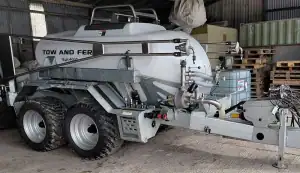
The ‘tow and fert’ advantage: the transition to a ‘tow and fert’ system allows for urea to be sprayed as coarse droplets. The savings are significant:
- Cost: purchased liquid N sits at £2.25/L, whereas melting your own costs just £0.75/L.
- Efficiency: this system has slashed application rates from 40kg N/ha (granular) down to just 7kg N/ha (foliar).
The “what if” scenario: farming without the bag
We asked Geoff and his agronomist, Ben Arthur (Monnow Agronomy), a tough question: if global tensions escalated and fertiliser stocks simply ran out, how would you survive the next two years?
Geoff: “I’d look at the value immediately to see if I was better off selling it for a crazy price or melting it to use as a foliar application on silage leys to secure the best first cut possible. Beyond that? We would quickly learn to farm without it by using alternative biological methods or converting to organic.”
Ben Arthur from Monnow Agronomy: “Nitrogen often drives disease, weed pressure, and crop weakness. If you remove the N, the need for other expensive inputs actually drops. To keep the system running, we’d lean on the tools we already know: clover understories, catch and cover crops, companion cropping, and organic manures. Profitability, not just yield, becomes the key metric.”
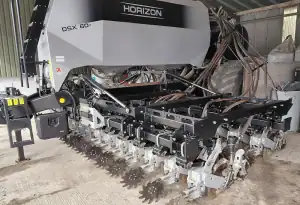
What’s in your shed: what are the key items of machinery that make this system work?
- Horizon direct drill for its ability to establish good crops into tall cover crops, and to work in a range of soil conditions and across all our soil types and crops.
- Tow and fert for melting urea and applying directly onto grassland. In arable, we use this for melting and mixing and the boom sprayer for application.